
Fixed asset depreciation at year end: from last year's register to Form 4562

Fixed assets are rarely the hardest part of a business return, but they are often the slowest. The prior-year register arrives from another system, the elections behind it are missing, and the federal and state numbers have to agree with each other and with the return.
Tax year 2025 adds a twist. The One Big Beautiful Bill Act changed Section 179 and bonus depreciation partway through the year, so the date an asset was acquired now decides how it is treated.
This guide walks through the year-end workflow step by step, with California as the state example, and then shows how Instead runs it.
Short answer: Carry the register forward, apply TY2025 Section 179 and bonus rules, tie Form 4562 to the return, and rebuild each state's book.
Step 1: Carry the prior-year register forward
Every current-year number depends on the prior-year schedule, so start by rebuilding it, not by retyping it.
The register can come from CCH Axcess Tax, UltraTax or Lacerte, from a spreadsheet, or from the client's own books. For each asset you need cost, placed-in-service date, recovery period, method, convention, any Section 179 or bonus taken, and prior accumulated depreciation.
Book registers are the common trap. A client register often shows straight-line book depreciation and says nothing about tax elections. Before you calculate anything, confirm how each prior-year asset was treated on the return: regular MACRS, bonus, or Section 179. Then check that the rebuilt schedule ties to last year's accumulated depreciation. Current-year MACRS on prior-year assets lands on Form 4562, line 17.
Step 2: Add this year's additions and disposals
Additions and disposals change both the deduction and the convention, so record them with dates, not just amounts.
For each addition, record the acquisition date as well as the placed-in-service date. For 2025 the acquisition date sets the bonus rate (Step 3). Then run the mid-quarter test. If more than 40% of the year's MACRS basis was placed in service in the last three months of the tax year, the mid-quarter convention applies instead of half-year. Real property and assets placed in service and disposed of in the same year are left out of the test (Publication 946).
For each disposal, take the final year of depreciation under the asset's convention, remove it from the register, and report the sale or recapture on Form 4797.
Step 3: Apply Section 179 and bonus depreciation for 2025
The 2025 rules depend on when the asset was acquired, so sort additions by date before you elect anything.
Section 179. For tax years beginning in 2025, the maximum deduction is $2,500,000, reduced dollar for dollar once Section 179 property placed in service exceeds $4,000,000 (Instructions for Form 4562, Rev. Proc. 2025-32). The deduction is also limited to taxable income from the active conduct of a trade or business (line 11), and any disallowed amount carries forward (line 13).
Bonus depreciation. Property acquired after January 19, 2025 qualifies for a 100% special depreciation allowance. Property acquired before January 20, 2025 and placed in service in 2025 is limited to 40%. For the first tax year ending after January 19, 2025, a taxpayer can elect 40% instead of 100% (IRS Notice 2026-11). Bonus applies unless you elect out, and the election out is made by class of property for the year.
That last point matters for the carry-forward in Step 1. If the client elected out of bonus in prior years, the current-year schedule has to follow that history.
Step 4: Complete Form 4562 part by part
Form 4562 is where the federal numbers come together, and each part ties to a different piece of the schedule.
- Part I, Section 179. Limits on lines 1 and 3, elected cost on line 8, business income limitation on line 11, carryover to 2026 on line 13.
- Part II, special depreciation allowance. Bonus on qualified property on line 14.
- Part III, MACRS. Prior-year assets on line 17; 2025 assets by class in Section B (line 19), with basis, recovery period, convention and method.
- Part IV, summary. Line 22 totals the deduction, and it should equal the depreciation on the return (Form 1120, line 20, for a C corporation).
- Part V, listed property. Vehicles and other listed property, with business use percentages.
- Part VI, amortization. Costs amortized under sections such as 195 or 197.
A corporation other than an S corporation files Form 4562 whenever it claims depreciation or amortization, even if every asset was placed in service in a prior year (Instructions for Form 4562).
Step 5: Rebuild the state book, with California as the example
States decide for themselves whether to follow federal Section 179 and bonus rules, so the federal schedule is a starting point, not the state answer.
California shows how far apart the two can be. For 2025 it generally follows the Internal Revenue Code as of January 1, 2025, before the OBBBA changes, and it does not conform to federal bonus depreciation at all. Its Section 179 deduction is capped at $25,000, reduced once qualifying property exceeds $200,000 (FTB 3885 instructions). Corporations report the difference on FTB 3885, and individuals, partnerships, LLCs and fiduciaries use FTB 3885A, 3885P, 3885L and 3885F.
| Rule | Federal | California |
|---|---|---|
| Section 179 maximum | $2,500,000 | $25,000 |
| Section 179 phase-out threshold | $4,000,000 | $200,000 |
| Bonus depreciation | 100% if acquired after January 19, 2025; 40% if acquired before January 20, 2025 | Not allowed |
| Corporate depreciation method | MACRS | California's own methods, not MACRS |
| Form (corporations) | Form 4562 | FTB 3885 |
California corporations also don't use MACRS. They figure depreciation under California's own methods, so asset lives can differ too, and a corporation can elect Section 179 or California's additional first-year depreciation in a year, not both. On the sample return below, the federal deduction is $92,397 and California's is $83,933. FTB 3885 line 18 carries the $8,464 difference to Form 100 as an addition.
The rest of the states vary. Some follow federal bonus, many do not, and several set their own Section 179 limits. Check each state the client files in every year, because conformity dates change.
How Instead runs the fixed asset workflow
Instead runs the same five steps as one workflow, from the prior-year file to the federal and state forms. Here it is on a C corporation return, Brightfern Robotics.
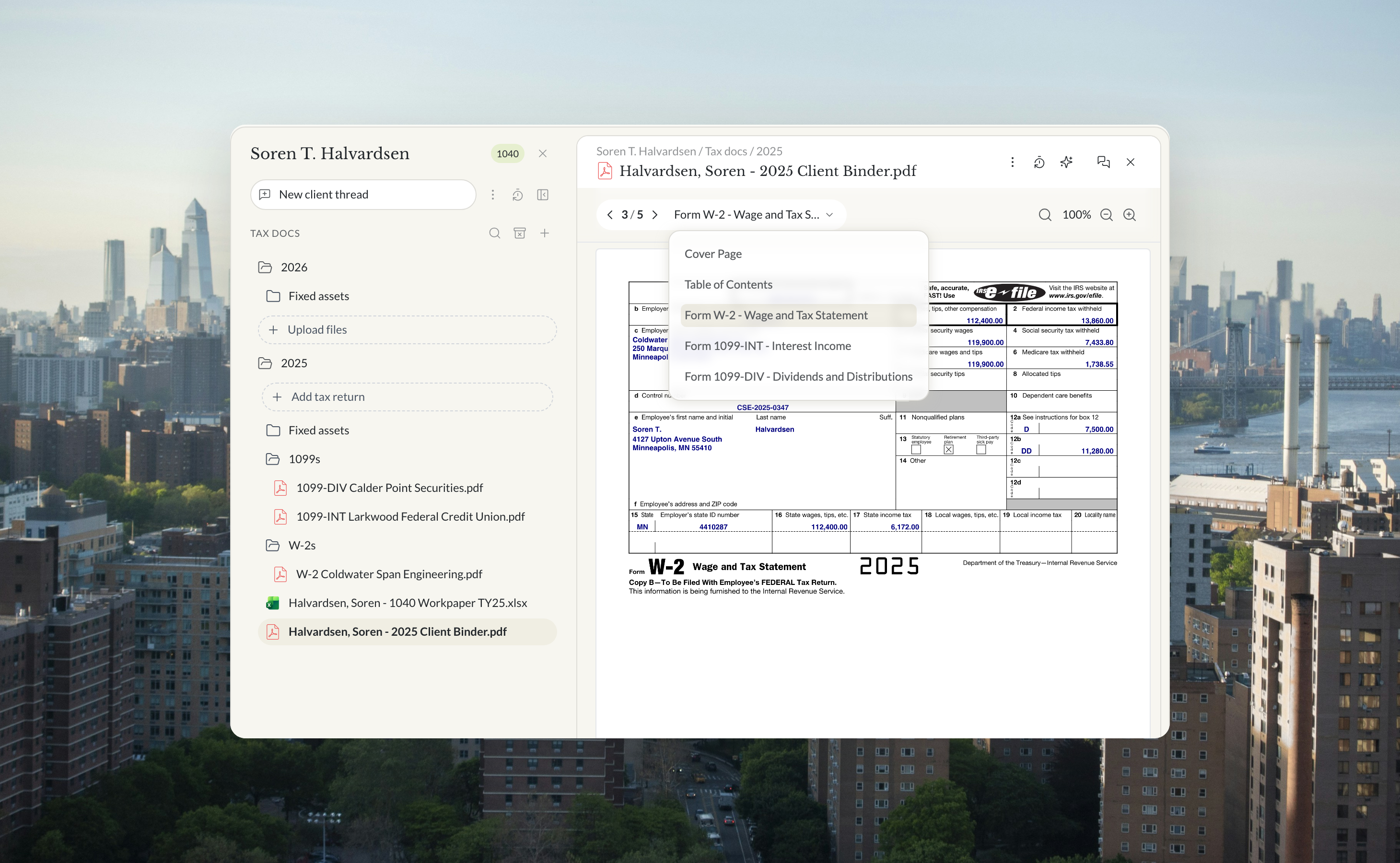
Upload the prior year. An export from CCH Axcess Tax, UltraTax or Lacerte, a raw file, or the client's own register goes into the client's documents.

The agent replicates prior-year depreciation, and asks when it can't. Brightfern's register shows book depreciation only, so the agent asked how the prior-year tax basis was handled before calculating.

Current-year depreciation, asset by asset. Add this year's additions and disposals and the depreciation schedule carries prior accumulated depreciation forward and calculates 2025 MACRS per asset.

Straight into Form 4562. The form is built from the same assets, with line 17 for prior-year assets and Section B for the 2025 addition.

Federal and state differences handled. The state form comes from the same assets with the state's own limits and lives. For Brightfern that is FTB 3885, with the $8,464 adjustment.

People still review the work. Every number traces to an asset, every agent question and answer stays in the client thread, and the reviewer checks tie-outs instead of retyping a register. See fixed assets in Instead, and for how review works across a return, AI tax return review.
A year-end review checklist for fixed assets
These five tie-outs catch most fixed asset errors before the return goes out:
- Prior accumulated depreciation on the schedule equals last year's ending balance.
- Form 4562 line 22 equals depreciation on the return.
- Acquisition dates support the bonus rate used on each 2025 addition.
- Mid-quarter test is documented, whichever convention you used.
- Each state adjustment equals federal depreciation less state depreciation, and it carries to the state return.
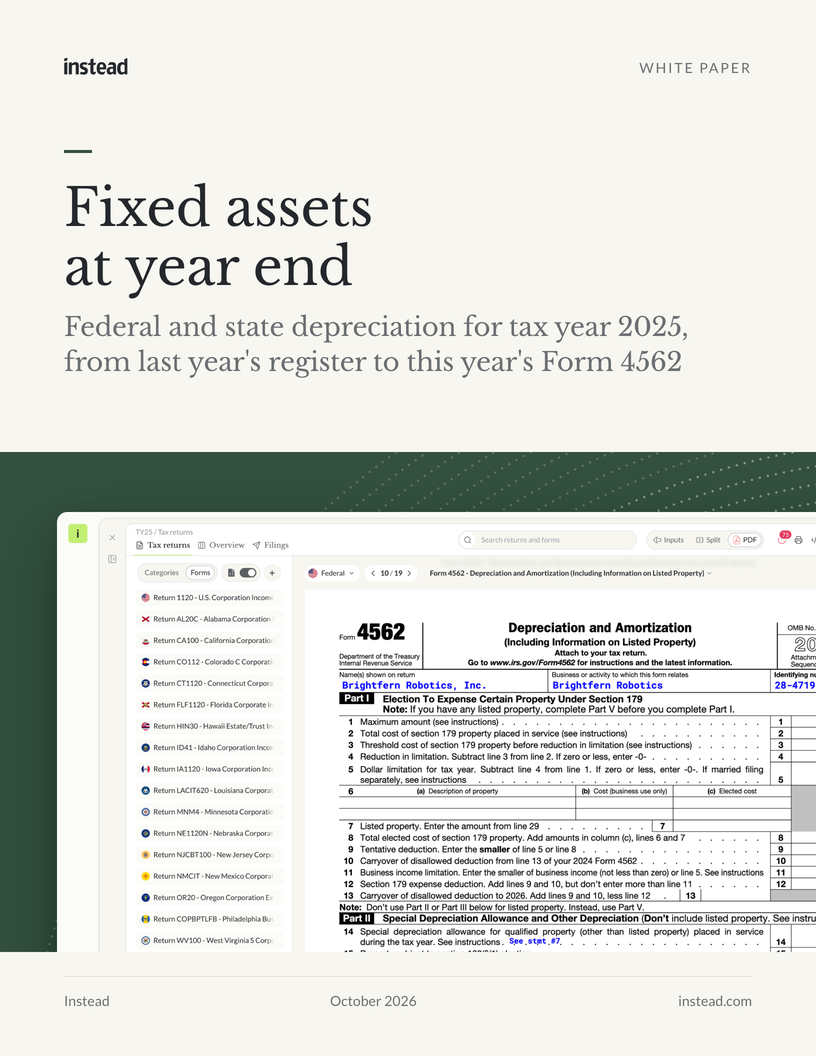
Free white paper
Fixed assets at year end
Federal and state depreciation for tax year 2025
The 2025 Section 179 and bonus rules, Form 4562 part by part, California and 11 other states side by side, and five tie-outs that cut review time. 12 pages, free PDF.
Download the white paperHow do you speed up fixed asset depreciation at year end?
Start from the prior-year file instead of retyping it, settle the election history before you calculate, and review tie-outs rather than every line. The Instead AI tax platform runs the register, the schedule, Form 4562 and the state forms from one set of assets, with people reviewing every step.
For federal and state conformity in more depth, download the white paper. To see it on your own clients, start your trial at instead.com.
Frequently asked questions
Q: What are the Section 179 limits for tax year 2025?
A: For tax years beginning in 2025, the maximum Section 179 deduction is $2,500,000. It is reduced dollar for dollar once Section 179 property placed in service exceeds $4,000,000.
Q: Does California allow bonus depreciation?
A: No. California does not conform to federal bonus depreciation, and it caps Section 179 at $25,000 with a $200,000 phase-out threshold. The difference is reported on FTB 3885 or its entity-specific version.
Q: When does a corporation have to file Form 4562?
A: A corporation other than an S corporation files Form 4562 whenever it claims any depreciation or amortization, even if every asset was placed in service in an earlier year.
Sources

Partner allocations, from last year's software to every K-1

The Destruction of the Billable Hour: AI's Impact on Accounting Firm Pricing in 2027

Year-End Tax Planning 2026: Checklist of Strategies by Dec 31



.png)